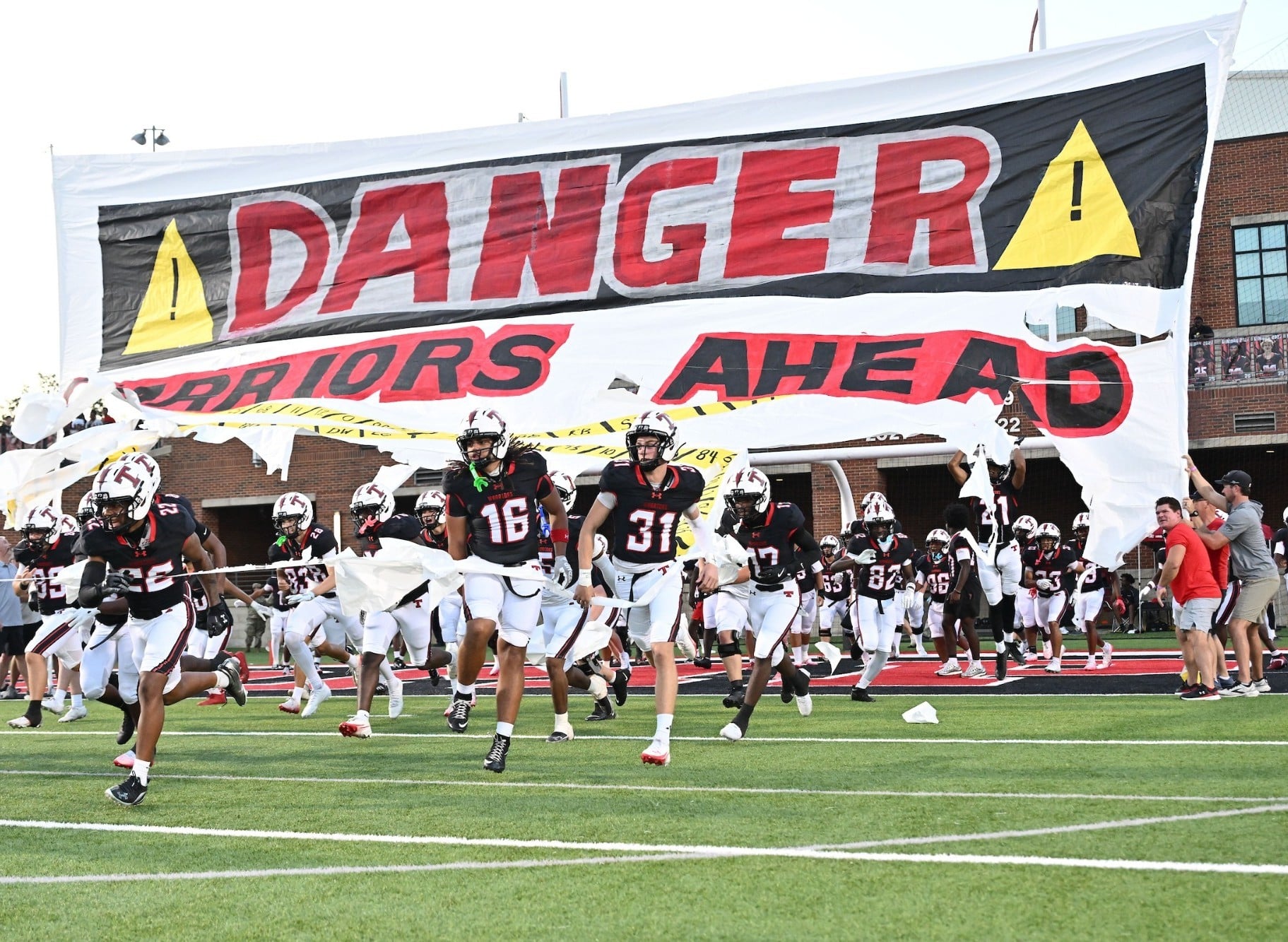
Thompson takes the field before its 49–0 victory over Vestavia Hills in 2026. Photo: Thompson High School Athletics
By David Sher
I have to admit I don’t know much about high school football.
But I have grandchildren who attend or previously attended Vestavia Hills High School, so I pay some attention to the Rebels.
On September 4th, Vestavia Hills was ranked No. 2 in Class 6A.
Thompson was No. 1.
Thompson beat Vestavia 49–0.
Forty-nine to nothing.
How’s that even possible?
That score got my attention.
So I started digging into Thompson football.
What I found was even more interesting than the score.
That 49–0 Score Wasn’t a Fluke
Thompson has played five games this season.
It has won all five.
The Warriors have scored 237 points. Their opponents have scored only 48.
Consider Spain Park.
Spain Park won its first three games and scored 94 points in the process.
Then it played Thompson.
Thompson won 48–14.
In its most recent game, Thompson beat Tuscaloosa County 62–7.
Meanwhile, Vestavia bounced back from its loss to Thompson and beat Spain Park 30–7.
So maybe that 49–0 score told me less about Vestavia than it did about Thompson.
From 0–10 to a Football Powerhouse
Before Mark Freeman became Thompson’s head coach in 2015, the Warriors had just finished an 0–10 season.
They didn’t win a single game.
Under Freeman, Thompson has won six state championships in seven seasons—four straight from 2019 through 2022, then again in 2024 and 2025.
That’s quite a transformation.
So how did a public high school in Alabaster go from 0–10 to one of the best football programs in Alabama?
There are some fairly obvious answers.
Freeman is an extraordinarily successful coach.
Alabaster has invested heavily in its schools and athletic facilities.
The community has a strong youth football program that feeds into the high school.
Success builds enthusiasm. It attracts families and gets kids interested in playing football.
All of that made sense to me.
Then I learned something I hadn’t realized about high school football today.
Some Players Began Somewhere Else
At least two of Thompson’s current standouts began their high school football careers at other schools.
CJ Cowley played at Spain Park and then Hoover before coming to Thompson.
Mason McClure played at Spain Park last year before transferring to Thompson.
When Thompson beat Spain Park 48–14 this season, McClure played a major role, catching two touchdown passes against his former team.
That surprised me.
My first reaction was probably the same one many people would have:
Can they do that?
And then:
Is Thompson recruiting these kids?
That’s when I learned that recruiting and transferring are two very different things.
Recruiting Is Against the Rules
The Alabama High School Athletic Association prohibits schools and coaches from recruiting athletes from other schools.
And apparently it takes that rule seriously.
Other Alabama football programs have been penalized for recruiting violations this year.
I could find no such finding against Thompson.
Students, however, can change schools, but AHSAA transfer and residency rules determine when they are eligible to compete.
That distinction is important.
A coach can’t simply go find a great football player at another school and persuade him to come play for his team.
But a family can decide that another community or school offers better opportunities for its child.
Success Attracts Talent
Suppose you had a son who was an exceptional football player.
He dreamed of playing college football.
You knew Thompson had won six state championships in seven seasons.
You knew it had excellent coaching, impressive facilities and a reputation that gets attention far beyond Alabaster.
Would that influence where your family wanted him to go to school?
I suspect it might.
And if families are making those decisions on their own and following the rules, there doesn’t seem to be anything improper about it.
Success attracts people.
We see that in business, universities and communities all the time.
Why wouldn’t it happen in high school football?
This Isn’t the Football I Remember
I graduated from Shades Valley High School in 1961.
That was 65 years ago.
My memory of high school football is pretty simple.
Kids went to their neighborhood high school and played for their school against kids from another community.
I’m sure it was never quite that simple, even then.
But I certainly don’t remember thinking about families changing schools because one high school had become a football powerhouse.
Maybe I’ve simply been out of touch.
But what I’ve learned about Thompson makes today’s elite high school football sound a little more like college football than the high school game I remember.
Successful programs attract attention.
Great players want to play with other great players.
Families look for the best opportunities.
And success can produce even more success.
None of this takes anything away from what Thompson and Alabaster have accomplished.
Quite the opposite.
Going from 0–10 to six state championships in seven seasons is extraordinary.
But I started looking into all of this because I couldn’t understand how Thompson could beat a good Vestavia team 49–0.
Now I understand a little more.
I’m still no expert on high school football.
But I do know one thing.
This sure isn’t the high school football I remember from 1961.
David Sher is the founder and publisher of ComebackTown. He’s past Chairman of the Birmingham Regional Chamber of Commerce (BBA), Operation New Birmingham (REV Birmingham), and the City Action Partnership (CAP).
4 thoughts on “Vestavia Hills Lost 49–0. So I Started Digging”
The history of sports programs in Siluria, Al ( now Alabaster) is very interesting .
Siluria, my hometown, was a cotton mill town created by a wealthy Birmingham man T C Thompson. The school gets its name from Mr Thompson as he built the high school in the 1920s for his mill workers.
Mr T C Thompson was a Birmingham socialite and he had a brother who was a mayor of Birmingham.
The cotton mill in Siluria made a commitment to sports in the area and started an industrial league baseball team which had an amazing win loss record for decades beginning around 1925.
I could go on and on about the mill baseball team but its record was amazing. .
The Buck Creek team wore uniforms with a big patch of a Buck deer. They were known as Buck Creek or the millers.
This baseball team provided much of the entertainment for the local mill workers which numbered about 500 workers who lived in houses built by the mill.
My grandfather , JT Phillps, began managing the team around 1927 when he came to Siluria as the mill manager. He came there at the request of Nr Charlie Cannon of Cannon Mills who was part owner in the mill with the Thompson family..
Most large cotton mills had baseball teams back in the 20s, 30s,40s. All the steel mills and industrial plants in Birmingham had mill sponsored baseball.
After WW2 the interest in baseball waned and high school football became the main sport in the area.
JT Phillips built a lighted field in 1948 so that both baseball and football could be played at night.
In a short time, the main sports interest became high school football. The first teams were in the 1930s. One of the early coaches was Art Hanes who became mayor of Birmingham. His son is familiar with this story., Art Hanes jr. and a friend of mine.
By about 1950, Thompson became well established as a football team. I remember Coach Gri Cashio was there around 1950 who went on the coach at Shades Valley with a long history there. Shades Valley was a football power house for decades.
A name that many remember was Jim Davenport who played football at Thompson and also played on the local mill baseball team as a teen ager.
I grew up one block from Jim or Peanut was his nickname. The golfer Hank Johnson grew up a block away. His dad was sales manager of the mill.
Jim Davenport went on to be first string 3rd base at the San Francisco Giants. The pizza place carry’s his name but that is because his good friend Hollis borrowed the name.
A love of baseball and football came out of this cotton mill village and was fostered by the local mill. The mill workers were big fans of both.
This is how baseball and football became so
Powerful in this area now called Alabaster.
The cities of Siluria and Alabaster merged in 1971.
The local mill closed in the 1970s.
The city of Alabaster made a decision to maintain the school name of Thompson as a tribute to the Birmingham contractor TC Thompson who built the local mill and high school.
My grandfather JT Phillips took over management of the mill in 1927 and became its owner in 1938.. He managed the mill baseball and sports programs as of 1927 up to 1959.
This is basic the basic history of how Thompson grew to become a sports power house. They continue to honor the man who started it all Mr T C Thompson of Birmingham. .
Addendum to prior comment.—
The city of Alabaster has been very successful in growth and many shopping centers and home subdivisions. They have created a large tax base.
The City board of education has pumped a huge amount of money into a new high school facility with a campus that looks like a college..
The city has earned this the hard way over many years of effort.
Yes, families have moved to the city of Alabaster to enjoy the benefits of the impressive new facility.. They had a humble beginning.
I remember the original high school building with outhouses for bathrooms up until 1951. I saw the old facility burn one night when I was about 7.
I may ad that Thompson has an excellent band that dates to the 1930s. I played in that marching band when elementary students were allowed to participate. In the 50s. I was in that band when Peanut Davenport was the star football player. He went on to play football at Southern Miss and beat Alabama and Bart Starr two years in a row at Crampton Bowl( ( Montgomery). Then, he switched to his baseball skills in the pros.
He played the first game at San Francisco as 3rd base. 1958. His dad Walt spent his entire career at the local.Cotton nill and a dozen other relatives.
Most of his male relatives were top notch athletes.
Several families in the area provided great players such as Davenports, Brogdens, Durrett’s..
cheers to a poor town that climbed to the top in sports. Let’s hope the education is as good as the sports.
Vestavia Hills lost 49-0 because Vestavia upholds academic priorities. Parents who want their child in a school that invests heavily in football and other athletics can go somewhere else.







The history of sports programs in Siluria, Al ( now Alabaster) is very interesting .
Siluria, my hometown, was a cotton mill town created by a wealthy Birmingham man T C Thompson. The school gets its name from Mr Thompson as he built the high school in the 1920s for his mill workers.
Mr T C Thompson was a Birmingham socialite and he had a brother who was a mayor of Birmingham.
The cotton mill in Siluria made a commitment to sports in the area and started an industrial league baseball team which had an amazing win loss record for decades beginning around 1925.
I could go on and on about the mill baseball team but its record was amazing. .
The Buck Creek team wore uniforms with a big patch of a Buck deer. They were known as Buck Creek or the millers.
This baseball team provided much of the entertainment for the local mill workers which numbered about 500 workers who lived in houses built by the mill.
My grandfather , JT Phillps, began managing the team around 1927 when he came to Siluria as the mill manager. He came there at the request of Nr Charlie Cannon of Cannon Mills who was part owner in the mill with the Thompson family..
Most large cotton mills had baseball teams back in the 20s, 30s,40s. All the steel mills and industrial plants in Birmingham had mill sponsored baseball.
After WW2 the interest in baseball waned and high school football became the main sport in the area.
JT Phillips built a lighted field in 1948 so that both baseball and football could be played at night.
In a short time, the main sports interest became high school football. The first teams were in the 1930s. One of the early coaches was Art Hanes who became mayor of Birmingham. His son is familiar with this story., Art Hanes jr. and a friend of mine.
By about 1950, Thompson became well established as a football team. I remember Coach Gri Cashio was there around 1950 who went on the coach at Shades Valley with a long history there. Shades Valley was a football power house for decades.
A name that many remember was Jim Davenport who played football at Thompson and also played on the local mill baseball team as a teen ager.
I grew up one block from Jim or Peanut was his nickname. The golfer Hank Johnson grew up a block away. His dad was sales manager of the mill.
Jim Davenport went on to be first string 3rd base at the San Francisco Giants. The pizza place carry’s his name but that is because his good friend Hollis borrowed the name.
A love of baseball and football came out of this cotton mill village and was fostered by the local mill. The mill workers were big fans of both.
This is how baseball and football became so
Powerful in this area now called Alabaster.
The cities of Siluria and Alabaster merged in 1971.
The local mill closed in the 1970s.
The city of Alabaster made a decision to maintain the school name of Thompson as a tribute to the Birmingham contractor TC Thompson who built the local mill and high school.
My grandfather JT Phillips took over management of the mill in 1927 and became its owner in 1938.. He managed the mill baseball and sports programs as of 1927 up to 1959.
This is basic the basic history of how Thompson grew to become a sports power house. They continue to honor the man who started it all Mr T C Thompson of Birmingham. .
If you are surprised at how good Thompson is, check out the salary of the head coach. Or other coaches of other powerhouses.
Addendum to prior comment.—
The city of Alabaster has been very successful in growth and many shopping centers and home subdivisions. They have created a large tax base.
The City board of education has pumped a huge amount of money into a new high school facility with a campus that looks like a college..
The city has earned this the hard way over many years of effort.
Yes, families have moved to the city of Alabaster to enjoy the benefits of the impressive new facility.. They had a humble beginning.
I remember the original high school building with outhouses for bathrooms up until 1951. I saw the old facility burn one night when I was about 7.
I may ad that Thompson has an excellent band that dates to the 1930s. I played in that marching band when elementary students were allowed to participate. In the 50s. I was in that band when Peanut Davenport was the star football player. He went on to play football at Southern Miss and beat Alabama and Bart Starr two years in a row at Crampton Bowl( ( Montgomery). Then, he switched to his baseball skills in the pros.
He played the first game at San Francisco as 3rd base. 1958. His dad Walt spent his entire career at the local.Cotton nill and a dozen other relatives.
Most of his male relatives were top notch athletes.
Several families in the area provided great players such as Davenports, Brogdens, Durrett’s..
cheers to a poor town that climbed to the top in sports. Let’s hope the education is as good as the sports.
Vestavia Hills lost 49-0 because Vestavia upholds academic priorities. Parents who want their child in a school that invests heavily in football and other athletics can go somewhere else.